
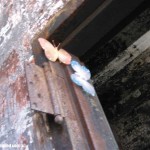
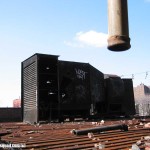
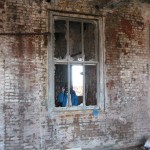
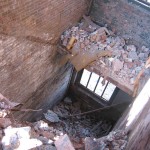
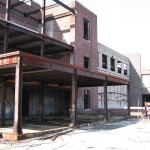
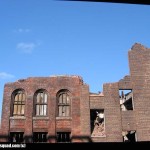


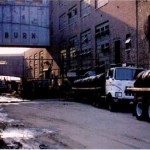
The Washburn wire factory in Harlem was the very likely the largest factory in Manhattan. After production shut down, the factory became a haven for drug addicts and the homeless – a vast ‘mad max’ wasteland where not even the police would enter.
History
The Washburn wire factory produced everything from coat hangers to wire for Amtrak’s northeast corridor and wiring for cars. It sat as an abandoned wreck from the time of its closing 1981 until 2004, when all of the buildings were bulldozed to make way for the East River Plaza mall. It employed anywhere from 600-1200 employees during its production peak. In the end it only employed around 250 workers.
It seems the original Washburn wire factory shut down in 1976. It was bought by a group of black entrepreneurs under the name ‘Harlem Community Council, Inc. who felt it could be made profitable. Their dream of preserving manufacturing jobs in Harlem was noble, yet flawed. (HCC & Washburn are profiled in the November 1978 issue of Black Enterprise)
In mid 1978 Washburn Wire Products Inc a Federally financed minority owned enterprise was established to produce prestressed concrete steel wire strand in Harlem In New York City In 1978 this firm secured a contract to supply this product to Amtrak for use in the manufacture of concrete ties in the Northeast corridor The firm had a rated capacity to produce million pounds of prestressed concrete steel wire strand in 1978 two thirds of this capacity was dedicated to the Amtrak contract Washburn’s bid for this business was well below the next lowest bid which was submitted by Florida Wire According to counsel for Florida Wire at the beginning of the delivery period under the contract Washburn was not able to meet the quality requirements of the specifications To perform its contractural obligations Washburn purchased prestressed concrete steel wire strand from Florida Wire at the latter s price After a time Washburn was able to meet the quality standards and for a period of about 6 months the company made deliveries to Amtrak from its own production Quality and financial problems continued however and on January 30 1981 the firm filed for bankruptcy In September 1981 the firm’s assets were sold in a bankruptcy sale
Source: “Pressurized concrete steel wire strand from Brazil, France, and the United Kingdom” – United States International Trade Commission, Abigail Eltzroth, Howard Gooley – 1982
Between 1981 and 2003, the Washburn wire factory “had been the focus of a succession of failed development schemes, including plans for a movie production studio.”
Source: http://www.nytimes.com/1998/03/29/nyregion/retail-center-is-proposed-in-east-harlem.html
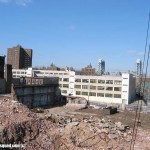
In the late 1990s, a plan for bulldozing the Washburn wire factory and create a mall was hatched. It wasn’t until late 2003 that demolition went into full swing. Several years later the East River Plaza opened, with anchor stores such as Target and Home Depot leasing out space. With it’s demolition, NYC lost one more manufacturer, and with it, a working class lifestyle of steady pay and union jobs.
Adventure: (Original Writeup from 2002)
AHOY, The Washburn wire factory from hell is on the horizon! But not fer long matey!
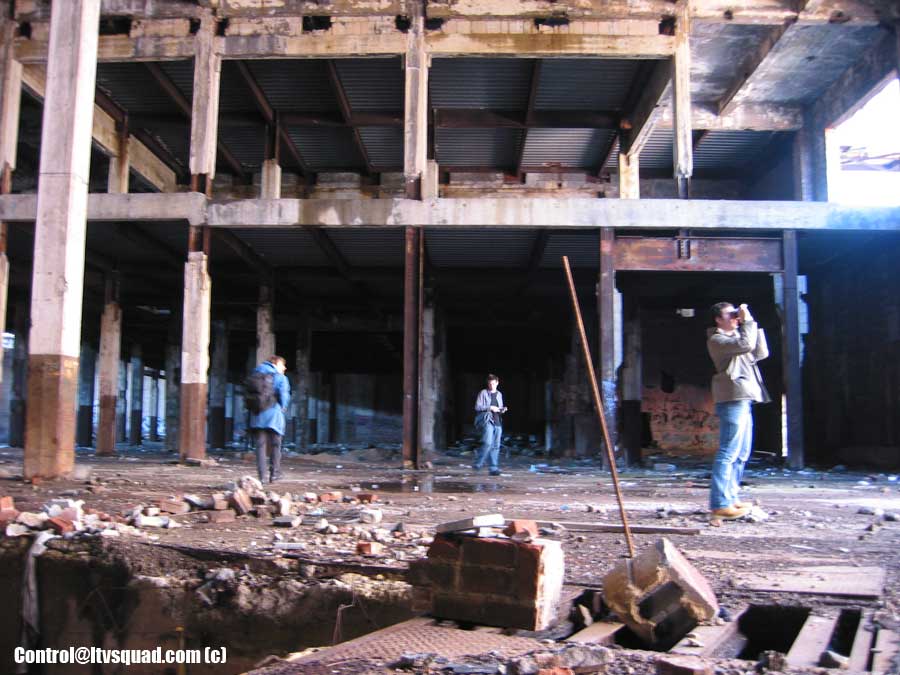
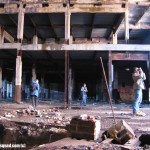
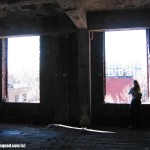
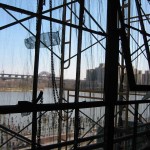
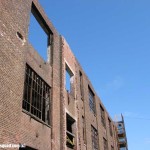
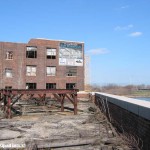
The Washburn wire factory is well known to anyone who has driven along the FDR drive in Harlem. It’s a massive set of 4 tall brick buildings, all long abandoned and all linked via overhead passages which are of questionable stability. Given the economics of the surrounding area, it should be of little surprise this location is both extremely accessible, inhabited by King Cobra swilling squatters, and often used for various (ill)legal activities. It is 5 stories and 4 buildings worth of criminal playground. And while that might scare some, it seemed like home to some of us… well… after we got past the fresh steaming loaf of shit someone laid in the front doorway…
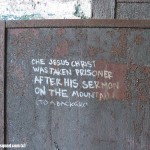
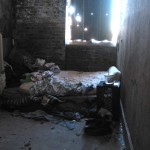
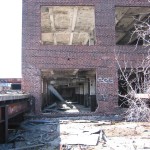
The first floors are the most heavily graffiti damaged, while even one level up you will find surprisingly bare, clean walls with peeling lead paint on them. Only the most hardcore of graffiti cats seem to have bothered climbing high to the rooftops of these structures, sprinting over the piles of used, aids ridden needles that heroin users have discarded in shockingly huge piles all over these buildings. Some areas around and in the steps contain human waste as well – perhaps someone reverting back to animal instinct to mark their territory. (If that was the case, someone shoulda handed them a few cans of rusto. at least it smells better!).
We press onward, examining the open areas which, without windows, are quite breezy and fresh. In the darker, smellier corners are where the squatters lurk, as if they were the C.H.U.D.s of the overworld. Occasionally they’ll walk by you and mutter ‘be careful’ from a distance… as if that was even an optional course of action in a location such as this?
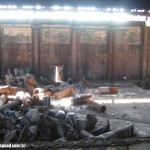
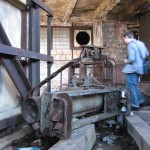
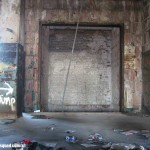
Just about all of the machinery that was in here is long gone. The once busy manufacturing floors have been filled instead with a strange mix of discarded porn, small children’s toys, a few books and of course needles. Needles, needles, needles.
Phuntastic as it is, we depart… knowing we may not see it again… you see, the southernmost building is already being leveled, and there’s a lot of talk in the news about building a shopping mall on the land… home depot, staples, etc.
And so the urban cycle of gentrification goes… grinding ever so slowly to pave over one more piece of NYC’s despicable, unsightly and phuntastic ghetto history. We are probably some of the very few who will miss this place, and the fewer still who weaponized their rigs and tied on large boots to explore this god forsaken place. It’s our job. It’s what we do.
(Adventure writeup originally written in October 19, 2002, History written up 4/3/2013. Photos from a later visit in 2003).


Leave a Reply to M.E. Cancel reply