
76th street – the puzzling evidence

For decades now there has been a mystery surrounding the ’76th street’ subway station. Some old timers claim that they actually saw the station, while others refute it as absolute fiction.

The layup
Between Euclid Ave and Grant ave on the A/C line, there is a set of ‘lay up tracks below the active A line. These tracks were built with the intention of building a new tunnel out to Cross Bay Blvd. The next stop past the solid concrete wall at the end was suppose to be 76th street.

IMG_3789

IMG_3791

There are several signals installed facing this wall – this one is just a few dozen feet from the wall – where a signal would make no sense to be installed unless there was track beyond the wall to fit an actual train.

IMG_3794

Another one is a ‘homeball’ set facing the wall, just beyond which a set of switches was intended to be placed.
IMG_3869

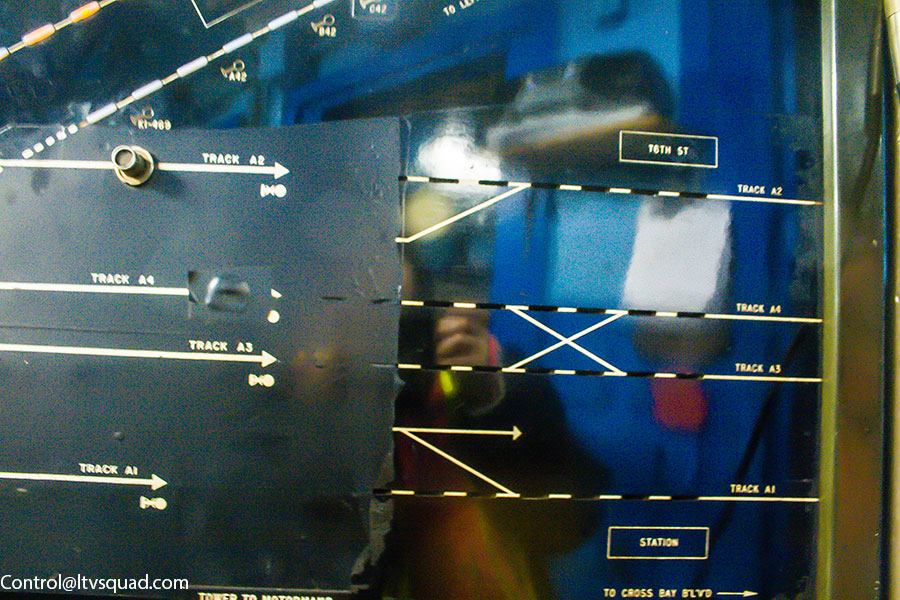
In a nearby tower, the board that shows the various tracks through the area explicitly shows a 76th street station.

IMG_3844

Plans are clearly marked that the signals in question would be controlled by a future tower at 76th street.

Pitkin Yard
The Pitkin subway yard is connected to this tunnel, and if you go to the yard and into the tunnel, you’ll find a yard lead was built pointing out towards the east – to connect to the 76th street station and Cross bay blvd route.

IMG_3806

Actual rail ties were installed at the switches.

IMG_3817

Here, you’ll find more signals facing the wall.

IMG_3824

The wall at the end is cinder block – and looks as if it were built as an afterthought – not an actual part of the concrete tunnel.

IMG_3822

The bench wall here looks like it was chipped out after it was constructed.
IMG_3821

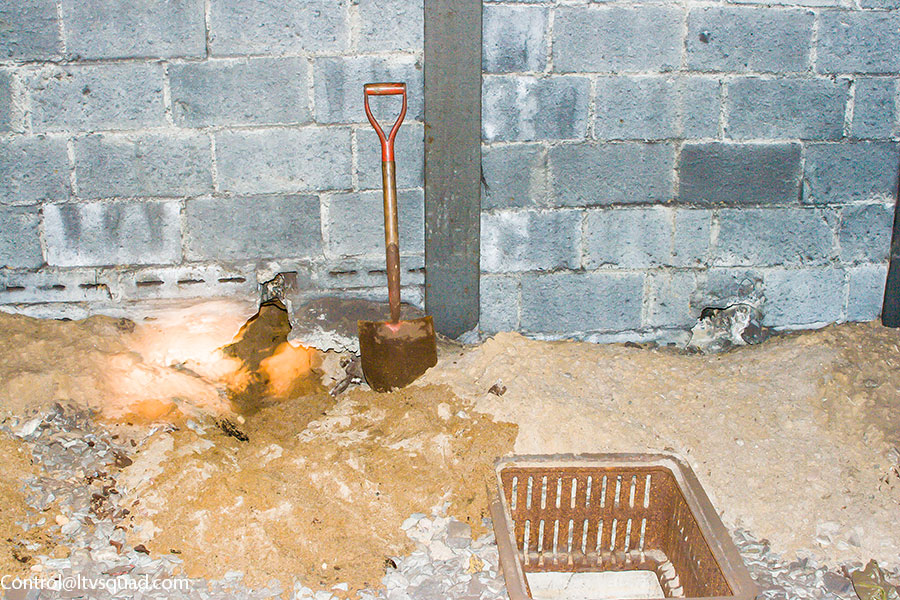
And still more mysterious, when you shovel dirt from under the wall, an almost endless supply of clean soil can be scooped out.

Conclusion

So what is behind these walls?

I have it on good authority that a few years ago, the MTA did some inspecting. When they drilled a hole in the concrete wall at the end of the layup, water began to trickle out. The test droll hole was quickly re-sealed.

As for the cinder block wall and soil, I can tell you several people have spent a few man-hours digging out sand and not getting through.

Was the whole tunnel filled in, or just a small section? How was this soil placed here? Was it always here in the ground, or was it purposely piled here? Wouldn’t the soil have been more gradually if they simply stopped the tunnel construction here, instead of a wall with soil packed in behind it?

Do I personally think there is a 76th station and/or more tunnel beyond the wall?
There’s just not enough evidence to say either way. The tunnel was definitely planned, the provisions for it were definitely built – right down to the signals – but what lays behind these walls – particularly the yard lead wall – are a mystery we would love to see solved.

Aye! Take a second to sign up for the newsletter where you’ll receive free exclusive content, discounts and insights.

Comments

35 responses to “76th street – the puzzling evidence”

  1. IBS Avatar
    IBS

    You need to break through that cinderblock wall and find out the truth, cuz no one else is going to.

  2. A Avatar
    A

    Please find out how much of 76 St is there it will show everyone it is real. You are the person to do it.

  3. BIG John Avatar
    BIG John

    When will someone go through that fucking wall and conirm if its there or not?

  4. Tom bauer Avatar
    Tom bauer

    Would it be possible to scan pitkin ave with ground penetrating radar? It will at least tell you if there is a void under the street or not

    1. Control Avatar
      Control

      Someone with deeper pockets needs to come and do that. Various other methods have been attempted over the years (some officially, some not), and this mystery persists.

  5. MTA Anon Avatar
    MTA Anon

    Anyone try going in through the grates by the cemetery on Pitkin around 79th – 80th st? From what I heard that’s the way in.

  6. Local Tourist Avatar
    Local Tourist

    MTA Anon
    The grates to those tunnels are at Conduit Ave with Sutter Ave, the southernmost one at around the intersession of Conduit Ave with 80th Street. Not by the cemetery… I don’t see what’s the need for radar technology if there’s a way in from above ground?

  7. Gene A Avatar
    Gene A

    Is there any evidence of a subway entrance to the mezzanine or platform on 76 ST.? That was my home turf I lived on 78 ST/101 AVE.

    BTW, just a side note, in 1976 while coming home from college on the A train, I missed the conductors announcement while at Euclid that the train was out of service. The doors closed and we sat for about 5 minutes then left, when I noticed something was different (turnout I never made before) I walked up the motorman, he was surprised and exclaimed &%$*#@ words and asked why I didnt get off at Euclid. He took us to the Pitkin yard we sat there another 5 minutes, he radioed the dispatcher to tell them he to backtrack to Euclid with a passenger. We walked up to the other end and he setup the controls and got clearance and we left for Euclid, along the way he was talking about the system and the tunnels and pointed out tracks to nowhere, was this the mysterious 76 ST station and tracks that I didnt know about at the time?

    1. Control Avatar
      Control

      Gene – great story – that was very likely the tracks intended to connect pitkin yard to the route to 76th street and beyond.

  8. Mike Avatar
    Mike

    Well, gee, Local Tourist – if you know where it is, then why not show photos of the station?

  9. MTA Anon Avatar
    MTA Anon

    Conduit and sutter? You’re off by a whole block local tourist. Like mike said, If you know the way in why don’t you go and snap some pictures. Speaking of digging under the wall off the pitkin yard leads, maybe it’s not digging that should be done. How about removing a cinder block at the top of the wall? That would require a ladder and tools but at least you’ll be able to see behind the wall.

  10. Russ Nelson Avatar

    You can buy an inspection borescope for like $20 on EBay. Plugs into a cellphone. Has its own lighting. So drill a hole at the top of the wall, stick a pipe through until it moves freely, then stick the borescope through to see what’s on the other side of it. Very little chance of permanent harm to the wall, the railroad, or you.

  11. M Avatar
    M

    Does anyone actually know where those grates by the cemetery go? MTA Anon might be onto something. The borescope thing is also a good idea, and if I had seen this a week ago I probably would have tried it while I was there.

  12. A Per/son Avatar
    A Per/son

    Hey, contact me for pics, progress made at that wall. A Videoscope/Boroscope won’t help. It’s LITERALLY filled from floor to ceiling, wall to wall with sand.

  13. MTA Anon Avatar
    MTA Anon

    A Per/son, email me Tgrand16@mail.com. I’d like to know what you found and what progress was made at the wall.

  14. motty.nyc Avatar
    motty.nyc

    i was by the layup and by the wall leading off pitkin where the wall is. why is it that progress was only made by the wall leading off pitkin and not by the layup? and i can also confirm that there is a endless supply of sand in that wall

    1. Control Avatar

      I have it on good authority that the MTA test-drilled holes in the wall at the end of the layup years back. These small holes were quickly sealed up when water started pouring out of them.

      Obviously not a good sign…

  15. motty.nyc Avatar
    motty.nyc

    CONTROL
    tried digging for 10 minutes but was getting a bit late/early, i will continue tho

  16. Matt Laptev Avatar
    Matt Laptev

    76th street station does exist.
    The Fulton Street subway was the Independent System’s main line from downtown Brooklyn to southern Queens. Construction was delayed by funding problems in the early 1930’s, solved by federal Works Progress Administration funding starting in 1936. That lasted only a few years, as work on the last portions in Brooklyn was then stopped in 1942 shortly after the nation entered World War II. The portion continuing from east of Rockaway Avenue station to Crystal St, not far west of the future Euclid Ave station, was let in 1938, and the next portion in 1940.

    After the war ended, workers and materials became available for civilian use again. The badly needed short run to a better terminal at East New York (now named Broadway Junction station) was finished in about a year, opening in December 1946. The last portion opened on 28 November 1948, running along Pennsylvania Ave and Pitkin Ave to the 76 St station just over the Queens border. It included access to a new train yard with access from both Euclid Ave and 76 St stations.

    The line no sooner opened than an unusual controversy erupted. Charges were made that the last portion had not been built and thus should not be operated. The local news media jumped on this, and in an article in the Queens edition of the Daily News for 30 November 1948, an unnamed engineer with the Fochla Brothers Contractors was quoted saying, “All I know is we built to the borough line like we were given plans, and we put up a solid concrete wall there. If they’ve knocked it out and built more, that’s fine with me, but I can tell you I never saw anyone working farther down the street than we were.” A tracklayer, also unidentified, claimed his crew had laid track to the end of their section and found another section of tunnel already completed.

    While the actual operation of trains to 76 St should have been enough to convince anyone the route existed, spooky rumors continued to spread. At the time the station opened, there were no houses at all on any of the four corners at 76 St and Pitkin Ave. A followup story in the News Queens edition on 2 December told the story of an area man who walked through the intersection each day to reach the Fulton St El station at City Line, a few blocks to the northwest: “I was walking home one day and noticed the new subway entrance. I was amazed because there was nothing there that morning. I don’t know how human beings could work so fast.”

    Pressed for a statement, Board of Transportation officials first scoffed but then days later admitted sheepishly that they could not produce contracts for construction or equipment of the portion east of Grant Avenue at the borough line. The unions, suspecting a cover-up of non-union work, threatened to take the matter to court. At this point, federal investigators stepped in. Long time local residents recall men with Air Force identification asking questions about the subway and any other unusual events in the area in the past year and a half.

    As a result of the problems related to its origins and existence, the 76 Street station was closed after less than a month of service, on 20 December 1948. The Board of Transportation covered the embarrassment by quickly preparing new maps and signs showing Euclid Avenue as the terminal, and no more was said.

    On 6 July 1949, the Board of Transportation officially adopted a plan to extend the Fulton St subway by diverging north out of Pitkin Ave at Conduit Ave and building a ramp up to the outdated Fulton St El located in Liberty Ave.

    The Hagstrom subway map showing the new subway line was replaced only a month later by a revised edition showing the line ending at Euclid Avenue.

    The only known photo taken inside 76 St station shows a train of new R 10 cars, delivered only a week before the station opened, with their original destination sign reading 76 ST /OZONE PK. This may have been taken on opening day. These were the first stations in the system to have fluorescent lighting, as shown here.

    And you thought it wasn’t there…

  17. DAVID SEDA Avatar
    DAVID SEDA

    there is something down there, find out before I PASS ON.

  18. enter.theunderground Avatar
    enter.theunderground

    For what it’s worth, while I think that there is space behind that wall, there’s no station back there.

  19. Ken C. Avatar
    Ken C.

    Considering the signal that faces the wrong way, I think it exists. For example The Atlantic Avenue tunnel was thought to be a myth until it was rediscovered in 1980.

  20. Tim Avatar
    Tim

    I’m as curious as everyone else about what’s there, but I don’t see the signals as being evidence at all. They’re in the plans, and they’re exactly where they’re supposed to be in the plans. Someone had a contract to build the line to where they did, and that included installing signals. There are many highway ramps to nowhere because they were part of some contract for a portion of construction that happened but the extension was later cancelled. Regardless of what’s behind those walls, those signals probably got installed with the rest of the line, sat working for many years, and then simply weren’t upgraded when all the rest were.

  21. david sanquiche Avatar
    david sanquiche

    chip from the top. And send a drone if there is empty space at the top. time to find out the real deal.

  22. Benny K Avatar
    Benny K

    I went on google maps, accessed the street view, and noticed the intersection of 76th Street & Pitkin Avenue has a concrete section on the road, which might mean something is down there.

  23. J Avatar
    J

    Benny K:
    Those concrete segments appear to be located at many bus stops along Pitkin. I would not take them as evidence for or against anything.

  24. jbr Avatar
    jbr

    https://www.columbia.edu/~brennan/abandoned/76st.html

    This is a link to the article Matt Laptev quoted with the picture mentioned. Interestingly enough it seems like a lot of the controversy surrounding its use is a result of capitalist exploitation. It sounds to me like they essentially hired a crew of scabs on the cheap to avoid paying the union rate and when they were called on it they covered up the stations existence as labor power in the city at that time was significant. Funny how that shit always just comes down to money and power. Thanks for all the work y’all do, maybe I’ll see y’all in a tunnel sometime.

    1. Bad Guy Joe Avatar

      Brennan’s article was an April fools day joke many many years ago. Looks like he might need to add a big disclaimer on it.

  25. Danny Avatar
    Danny

    76 exists, read the columbia article on it

  26. James Bailey Avatar
    James Bailey

    I.think.there .is.a.station.there.and.on.the.conduit.I.believe.theres.a.76st.station.underthere.if.there.wasnt.why.is.it.walled.off??

  27. twospirits Avatar
    twospirits

    The funny thing about Brennan’s article being written and listed as April 1st 2002, is that it does not appear listed in his Abandoned Stations list until April 2012. According to the Wayback Internet Archives database. So either he forgot to add it to his list or most likely added it as a April Fools joke in 2012 to look like it was added in 2002.

  28. Tales0fNYC Avatar
    Tales0fNYC

    I believe something is definitely back there it might not be a full on station or it might be or just halfly completed who knows just waiting for the day when some kids break in there and they post the photos online.

  29. provision Avatar
    provision

    While backwards signals and track boards are some pretty solid evidence that points to the existence of a station at 76th St, if you look at a detailed track map that was released by the NYCTA in 2024 you can see evidence that points directly to the existence of a station. While there is no station or platform labeled there is a huge stub tunnel in the form of a provision connected to the pitkin yard connection but points in the opposite direction. In addition, there is also a closed off set of tracks labeled in the track map that are part of the Grant Ave layup. I believe that with this information and other historical evidence that I will list below all points lead to some anomaly underneath 76th St. The station would have been constructed in about 1935 and would have been part of the Fulton Street Line and would have most likely followed the station layout consisting of one mezzanine and two side platforms that were similar to other stations on the same line. With this information you can plot out two 5 car platforms on the track map and still have room to connect to the rest of the line. If i had to guess the 76th street station would have served as an express station that would have surpassed the Grant Avenue Station which was actually constructed AFTER the rest of the Fulton Street Line in 1956. This means that the 76th Street station might have been in service for a few years before its closure. There might have been a fire or some kind of crime that cut that part of the line off and rerouted it around it constructing the Grant Layups. This would make sense as the Grant Avenue layups would have been an active trackway and is listed as an “unfinished” Bellmouth in the NYCTAs records. Additionally, other abandoned stations that experienced a fire or crime have been completely cemented and patched up like the South Fourth Street Station, Manhattan Wine Cellar, Second Avenue V train layups, Sedgwick Avenue station, and the Nevins St extension have all been filled in or cemented shut because of fire or crime. I have also flipped countless manhole covers around the area and have found nothing. While the MTA denies the existence of a station at 76th Street it is up to future Urban Explorers to unveil the mystery at 76th St.

  30. Ben H Avatar
    Ben H

    I found some gratings embedded in the street at the Pitkin and Eldert intersection, they’re far too east for the grant avenue station, and they definitely don’t run into a sewer. Anyone know what this is?

    1. Control@ltvsquad.com Avatar

      Could be a Con Ed vault.

Leave a Reply to motty.nyc Cancel reply

Your email address will not be published. Required fields are marked *