
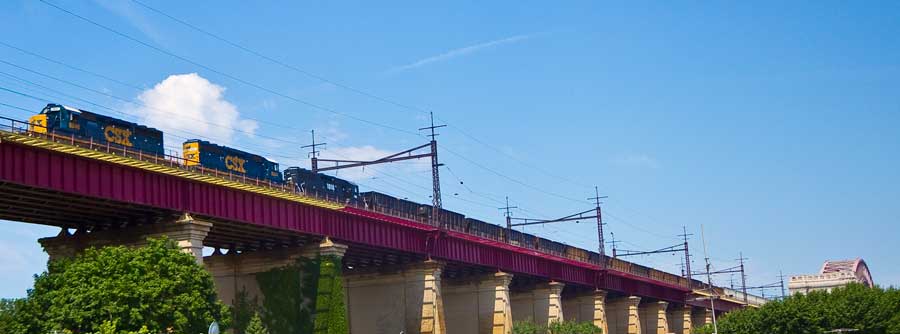
Do you want to see the city spend 10s of millions of dollars condemning hundreds family homes? Would you like to see severe service disruptions to the N and Q lines in Queens, including a potential full closure (to last months, or years) of the entire route between Queensboro Plaza and Ditmars blvd? Do you want to pay more in taxes to have your household trash trucked out of NYC? Or perhaps even see the reopening of the Staten Island landfill? Do you want to pay more for everything from Chinese food to plywood at Home Depot, and even higher rents in new buildings?
If the ‘Triboro RX’ subway line were to be built, all of the above would happen. This might sound like hyperbole, but when you take a serious look at the facts I’m going to lay out, you’ll see what I mean.
Do you want to pay more in taxes to have your household trash trucked out of NYC? Or perhaps even reopening of the Staten Island landfill? Do you want more trucks on our already limited and very strained highways? Do you want to pay more for everything from Chinese food to plywood at Home Depot?
Background:
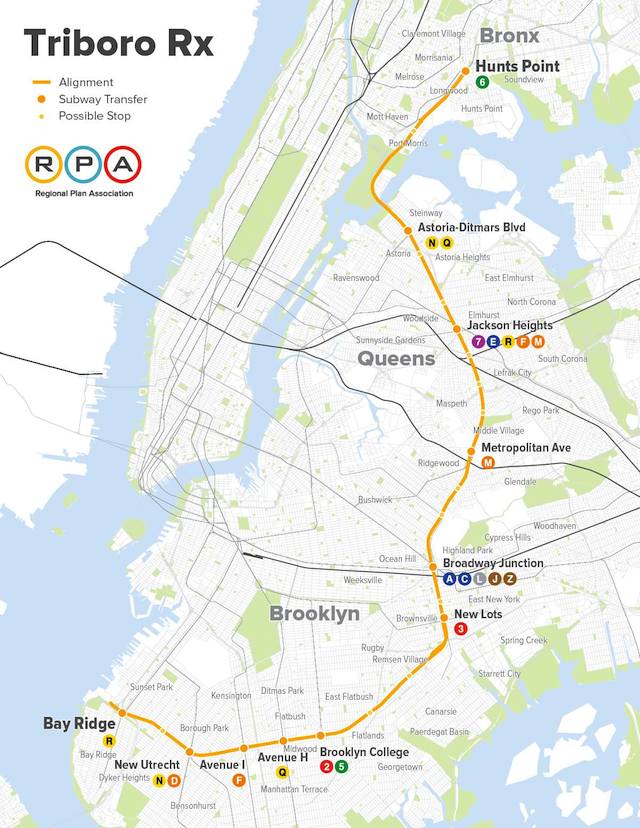
For those that don’t know, many years ago in 1996, transit advocates have proposed the “RX” subway line which would create a subway loop from Bay Ridge to the Bronx, utilizing the right of way of the New York and Atlantic railroad’s Bay Ridge branch and CSX’s “Fremont” line. This plan is largely based on census data, perceived need, and the fact that someone somewhere drew a line on a map without ever looking at the actual huge physical and economic obstacles which completely block the creation of this this subway route.
The Obstacles:
Lets start with the economic obstacles. The majority of the route is currently heavily (not “lightly”) used by 4 railroads (well – 5 technically). These railroads move thousands of freight cars to and from Queens, Brooklyn and all of Long Island every year. This is a large steadily growing business involving slow moving heavy freight trains of up to 100 cars in length. The northern end of this route sees as many as 5 freight trains per day. The south end generally sees one every day or two, which stops often along the route to switch freight cars at a variety of customers (thus taking around 4-8 hours to complete the route).
Out of the gate, you’re dealing with several large for-profit companies who own the tracks and who will want a very large amount of money to share them (or who would win in federal court if anyone tried to force them off their property – railroads don’t answer to local governments – it is protected interstate commerce). The company with the deepest pockets is CSX, who makes millions off of this route annually. At the Bay Ridge end of the line you have the NYNJRR, which is owned by the Port Authority of NY & NJ – which obviously also has deep pockets and a deep growing investment in railroad infrastructure around the port of NY (NYNJRR was a privately held company up until a few years ago – the Port Authority has been growing it ever since). They are in the process of opening a large new rail terminal in Sunset Park.
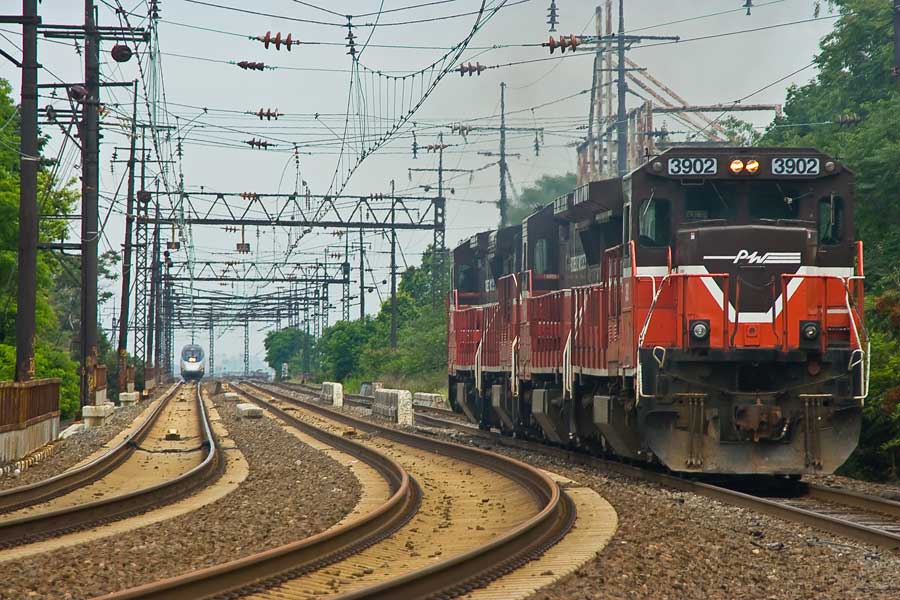
There are some transit advocates and naive politicians who believe that these tracks are “lightly” used – they are completely wrong. I’ve heard some claim there is so little freight traffic that they can simply get rid of the freights altogether. These people are severely misguided to a point of being dangerous. There is no eliminating the freight trains, not without great cost to the entire region and huge taxpayer expense.
Here are just a few big problems NYC would face with the loss of these freight tracks:
1) Trash Removal. The NYC government depends heavily in these freight trains to remove up to 33% of NYC’s household trash. That is around 24 loaded trash cars (equal to 50semi trucks) being moved 6 days per week. Loss of freight rail would result in millions of trash truck trips via our already overtaxed, limited highway system. The fuel, toll and trucking costs would result in higher taxes for all NYers. The only way to offset it would be to do something drastic, like reopen the Staten Island landfill, or perhaps create some new ones. Maybe every neighborhood could have its own landfill instead? Since there is no real estate for landfills in NYC, we would need to convert neighborhood parks to landfills, or come up with some other insane scheme to deal with the unrelenting production of trash in NYC.
Rail is one of the cheapest ways to get the trash out of NYC. Garbage is quite literally NYC’s largest export.
Rail is one of the cheapest ways to get the trash out of NYC. Garbage is quite literally NYC’s largest export. (Yes, this is a fact).
2) Food prices would go up. In Maspeth and Long Island City, boxcars full of everything from Rice to Soy Sauce are unloaded at warehouses, on its way to restaurants all over NYC. Western Beef in Bushwick unloads freight cars of meat and beer. Shipping by rail is significantly cheaper than via truck (especially with NYC’s restrictive tolls, endless traffic and relentless ticketing of delivery vehicles).
3) Everything in Home Depot. After Hurricane Sandy hit NYC and forced the closure of many area highways, Home Depot’s supplies ran short – so they wised up and started using rail. They currently receive up to 35 freight cars a week at a distribution center on Long Island. The cheaper transportation costs keeps the retail prices of everything from bricks to plywood cheaper than if they were transported here by truck alone. The added supply line means store shelves will be stocked for the next major storm to blow into town.
4) Cement. No, you don’t need it, but ‘real estate developers’ sure do. At least half of the stone that is used in the cement making process comes into town via freight rail. If the stone costs more to truck in, it’s going to cost you more in rent in new buildings. The added construction costs will be passed directly on to consumers. Period.
5) Thousands more trucks traveling to and from Long Island. Think about all that smog, and how many people will surely get run over with all those trucks trying to cut through Manhattan on their way to NJ. NYC receives an astonishing low 3-4% of goods via rail as it. Imagine how many less trucks and how much less smog there would be if we received just 20, or 30% of our goods via rail (as most US cities do)
“Why can’t you just run the freight trains at night?” That isn’t a viable option. Some of these trains already move at night. It takes each train at least an hour just to move from oak point to fresh pond. The full round trip takes 4 hours. You could move 4 or 5 trains overnight, tops. That would barely preserve current freight needs and would leave them at max capacity – and this is a growing market where there will be more freight trains in the future – not less. NYC simply needs freight only tracks. The LIRR recently turned over its entire ‘Lower Montauk’ line to Long Island freight operator NYA, due to their rapidly growing business along this route (and lack of any passenger service – which ended in the late 1990s due to lower ridership (approximately a dozen passengers per day)). A growing city requires solid supply lines for large bulky items not well suited to road travel. While trucks will always dominate the inter-city delivery market, there’s no reason at all to hand these companies a monopoly and drive up consumer prices even more.
Physical obstacles:
We haven’t even touched the physical obstacles yet.
The first one you’ve heard assuming you are familiar with this issue is that federal regulations require that any commuter rail cars sharing tracks with freight trains must be built to a higher standard of crash protection than any current NYC MTA subway cars are designed for. The MTA doesn’t have extra train cars to provide this service even if the FRA gave them a waiver, so they would have to be ordered new. A new train yard would have to be built to maintain them. Congrats, You’ve just spent around 100 million dollars of taxpayer money, by the way.
Since you’re not likely to get the FRA waiver, the subway route would need separate tracks from those used by the freight trains. You would need a “right of way” (land that the tracks are on – also known as an ROW) that is 3 at least tracks wide. One for freight, the other two for subway. This does not currently exist.
The ROW from Fresh Pond Yard in Ridgewood, to Oak Point Yard in the Bronx, is only wide enough for 2 tracks. Much of the route only has one track in place now, though approaching Fresh Pond, there are 2 freight tracks in service. They cross the Lower Montauk freight tracks at bridge 35 – which again is 2 tracks wide. The route crosses Queens Blvd on a viaduct that only had space for – you guessed it – 2 tracks. The tracks also cross the 3 mile long Hell Gate bridge. While the main span of Hell Gate was designed to accommodate 2 transit tracks, the viaduct approaching it was not. Amtrak uses two of the 3 tracks for its northeast corridor, where intermingling of subway cars could never happen. CSX has one freight track, leaving space for a single subway track across the viaduct. To expand the viaduct would mean the condemnation and demolition of up to 85 homes along the viaduct, along with at least one church and the Astoria 11105 Post Office. Most of these 85 homes are currently valued in the 700-900k dollar range (2013 prices – these go up every year by at least 50k). After demolition, you’ve just spend at least 85 million just to create space for the wider viaduct – not including all the lawsuits, police overtime at protests, etc. The cost of iron, new wider bridge piers, etc would run into the billions. And this is for maybe a 2 mile segment of the route! (The entire route is roughly 14 miles total).
Let’s just say community resistance would be harsh.
Astoria Subway Service: Suspended Indefinitely
A new station for the RX route at the Ditmars N/Q stop would require the widening of the hell gate viaduct even more to accommodate at least 1 center platform. Due to the track configuration of the N and Q line (see the attached track map), as well as Ditmars nature as the terminal station of the N/Q lines, This construction would likely require the N and Q to be shut down from Ditmars all the way to Queensboro Plaza during construction. There simply is no other station along the line configured for use as a terminal, with switches to turn trains at. This is a very busy route and such a massive disruption would likely be met with outright protests. It would likely take at least a year to build. The value of property in the area would drop like a brick.
The N and Q are very congested with commuters going largely to Manhattan. An RX station would draw little ridership from northwest Queens residents. The transfer would likely deposit more riders at Ditmars, which is already cramped. Most rush hour trains are standing room only by the time they leave Astoria blvd. And thanks to the ‘upsize everything’ Vallones, all of western Queens is growing in population. The MTA should be considering adding a new tunnel/route to the area (say, a tunnel up 21st street and maybe over to LGA) – and definitely not anything that would deposit more riders onto a route that is already stretched thin.
Central Queens also hit.
Leaving Astoria and following the freight tracks south, the bridge over the BQE (just rebuilt 15 years ago) would need expansion, creating a temporary traffic mess. 8 street overpasses might need modification or replacement, all at significant taxpayer costs. Closer to Fresh Pond, a tunnel would need to be widened. The area would get transit service though, so NIMBY resistance might be less. Then again these same residents formed a very group called ‘CURES” whose sole aim is to completely eliminate freight trains in and around Fresh Pond yard. If just a few freight trains upset these people, commuter trains passing by every 10 minutes would drive them completely insane. The people who live in this part of Queens drive everywhere. When they had passenger service along the LIRR Lower Montauk, they didn’t use it.
Fresh Pond to Bay Ridge.
Do I even need to explain the obstacles involved in the Bay Ridge line? There are similar long segments of narrow ROW which could not accommodate more than 2 tracks and would require extensive construction. There are at least 33 street overpasses and 2 tunnels that would require widening or complete replacement, and hundreds of homes that would likely require demolition to widen the ROW.
For a complete separated 2 track subway line, the costs are far more than this city can brunt. We are talking 10s of billions of dollars here. It would be Robert Moses, 2013 edition.
For a complete separated 2 track subway line, the costs are far more than this city can brunt. We are talking 10s of billions of dollars here. It would be Robert Moses, 2013 edition.
This does not mean a transit option in this route is beyond question. In fact it may be very affordable in our lifetimes.
“Heavy Rail”: A more realistic option
A heavy rail commuter train could use the same track as the freight trains. Think Metro North, or Long Island Railroad. A second track would need to be installed along the entire length of the route. One of the yard tracks at track at Fremont/Fresh Pond would need to be replaced, perhaps with a new long siding south of the East New York tunnel where the ROW can fit at least 4 tracks. This limited service could run every hour or 2, with windows for freight trains to get through, and co-exist with them.
This option (along with the subway option) would still require a complete rehabilitation of all existing tracks / which are suited for slow moving freights but not at all safe for higher speed passenger trains. This would cost many many millions. Additionally, the MTA doesn’t own any locomotives or passenger cars to run this service with. You would need at least 20 passengers cars, and 4 or 5 locomotives, to provide minimal service. Oh and actual employees: drivers, conductors, cleaners, maintenance crews… All of these things cost way, way more money than our lying politicians have lead on. The MTA stated each station would cost millions – plus millions for the actual trains, millions for new track that is up to commuter rail standards, etc etc. A conservative estimate would be a billion dollars for this option, minimum. Personally I think this is the only realistic option for providing commuter service along this route. If it proved popular, improvements could be made and the political/social will to do so would increase.
This absolutely stupid idea would require a 2 lane road be built along the tracks – roughly the same width requirements of a subway line.
Or there is the logical choice
One argument for creating the RX subway route is to provide a fast transit option for those who live in the Bronx but work in far east Brooklyn, and vice versa. I have a great solution for these people: MOVE CLOSER TO WHERE YOU WORK.
I know a lot of people will not like that idea – but it’s true. In many large cities, commute time is significantly less because people can afford to live closer to work. This opens the window to a huge conversation about housing costs, infrastructure, how slow our ‘express’ services are, etc – but we would be here for months arguing about it.
I’ve always lived close to where the work is – because long commute times are a well documented source of stress and bad health. How best to balance work/life/commute is a riddle as old as NYC itself. Only you can decide what works for you.
Then there is the stupid…
“Mayor” Bloombergs pick for NYC’s news Mayor, Christine Quinn, naively stated a dedicated bus route could be built here for less than 25 million. This absolutely stupid idea would require a 2 lane road be built along the tracks – roughly the same width requirements of a subway line. Think all of the costs of subway option mentioned above – the bridge building, N/Q disruption, homes condemned, etc. All of that work would be required, minus the track, and plus hundreds of buses and drivers. Oh and they would have to be driven across a 3 mile long bridge without the driver going over the guard rail…. Christine Quinn definitely wins my aware for stupid, lying politician when it comes to the Triboro RX topic.
Conclusion:
While its very easy to draw lines on a map and say “this should happen” – actually doing it is significantly more complicated and considerably more expensive than anyone advocating this subway line has bothered to understand. It’s one thing to sit behind a computer and say let’s do it, it’s something else entirely to actually look at the economic and physical obstacles. Because when you do – you know beyond any shadow of a doubt that the Triboro RX subway will never, ever happen.
As I love to say, I am a firm believer in better transit options around NYC. That doesn’t mean I’m not going to call bullshit on really stupid ideas when I see them. Reactivating the old LIRR Rockaway beach branch would yield far, far more bang for our taxpayer dollars. Transit advocates should be picking their battles and choosing realistic ones, not pie in the sky Robert Moses style insanity.
About The Author: I’ve written 2 books about these tracks, and have walked every inch of the entire proposed RX route. I’m an infrastructure nerd who knows more about this topic than anyone in their right mind should. Period. (I also have one about hidden spaces in the NYC Subway system – so anyone that thinks I hate subways from reading the above obviously needs to read more.
UPDATE 9.14.2013:
According to 2nd Avenue Sagas, the above article is both obnoxious and compelling. Let me ask though – what’s more obnoxious? Someone dropping facts or politicians and the media lying to the people by claiming the RX route can easily be built? What I wrote was designed, word by word, to be obnoxious and a cold hard slap of reality to the face of these lying, dangerous politicians and the media outlets that parrot their every word without doing any actual journalistic investigating. Again, I’d love to see more transit options around town – but let’s look at the complete picture. Basing decisions off faulty, navel gazing dreams and not present reality helps absolutely no one and gets absolutely nothing done, ever.
Also, someone quipped that I’m an advocate for the long dreamed, never going to happen harbor freight rail tunnel. That’s simply not true. The Port Authority has currently put out a bid for new carfloats to move freight cars from NJ to Brooklyn. Carfloat traffic today has significant room for growth at the Bay Ridge terminal and the facilities on the NJ side could be expanded if needed (though they were destroyed by Hurricane Sandy). Carfloats get the job done, and used to be significantly more popular 50 years ago… Bring them back.


Leave a Reply to Control Cancel reply