
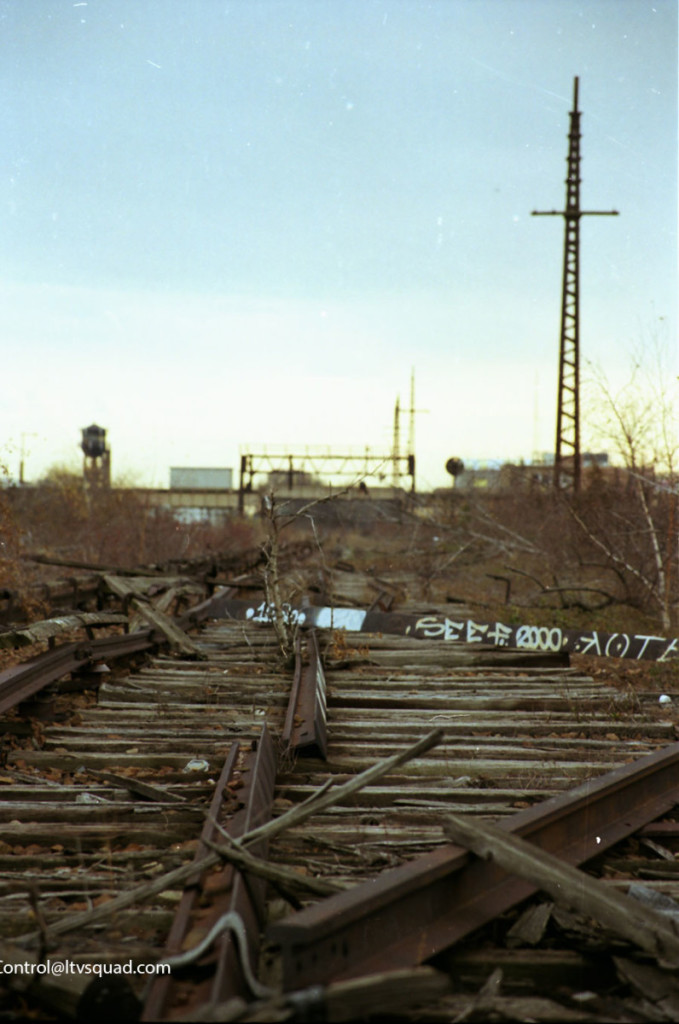

In 2002, Me, M, and a reporter climbed up onto the old LIRR Rockaway Beach tracks in Ozone Park.
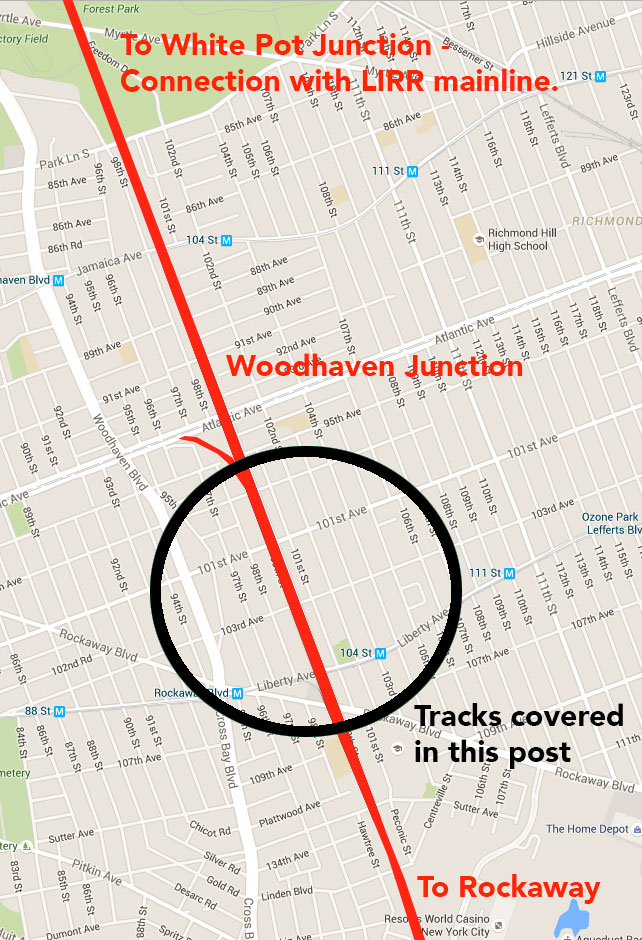
This post is one in a series covering the entire length of the former LIRR Rockaway beach branch, which ran from the current LIRR mainline in Rego Park, all the way to Rockaway. In this article, we will be looking at the viaduct that runs through Ozone Park, containing the shell of a once busy transfer station.
History
For much of its history, the LIRR made no money. Beginning in 1900 it was owned by the much larger, more profitable Pennsylvania Rail Road (PRR), which subsidized it. As the PRR’s own fortunes declined, they were forced to stop funding the LIRR in 1949.
In this pre-MTA era, service cuts were forced, and one of the worst cuts of all was to the Rockaway Beach Branch. At the time, the trestle south of Ozone Park and across Jamacia Bay was a wooden structure prone to fires. It was an expensive money pit for which the LIRR had no cash to maintain.
Thus, the tracks south of Ozone Park were sold to the city, which completely rebuilt the viaduct & bridge to Rockaway. Today, this portion of the Rockaway Beach Branch is better known as the ‘A train’ – running 24/7/365 between upper Manhattan and far Rockaway. Subway service began on June 28th, 1956, and has only been occasionally interrupted for maintenance and serious storms like Hurricane Sandy
Meanwhile, North of Ozone Park, the LIRR was still limping along in bankruptcy. The truncated route was soon deemed unprofitable. The last LIRR train ran on June 8th, 1962.
Today, transit advocates (myself included) want to see these tracks reopened, while park advocates would rather see the route turned into a greenspace. The park advocates like to claim that these tracks are ‘a failed transit route’, which is 100% not true. Had the LIRR been properly funded in the 1950s and 60s, these tracks would never have been abandoned. Another option would have been for the city to convert the entire route to subway usage, construction a connection to the Queens blvd subway in Rego Park. Had this happened, it would have created a very busy, successful subway route through Queens.
Adventure and more recent history
Climbing up here isn’t too hard, and if you don’t walk along the edges, you’re surprisingly out of view from the streets below.


Ozone Park Station
On a nice spring day in 2002 myself, M and a journalist made the climb and enjoyed the hike. We started at the north end and walked south, passing through the remains of Ozone Park station. There’s not much to see here – only high level platforms and old signals remain. The station is nevertheless amazingly long. It was built so two full length trains could be at the platform at the same time.
There was also an old control tower here once called ‘Ozone tower’. It is rumored that the NYPD built a fake wood version of Ozone tower to set up spy cameras to keep an eye on notorious mob boss John Gotti – who kept his social club/office nearby. According to local lure, one 4th of july this fake structure was set on fire by ‘unknown’ arsonists, completely destroying it.
The tracks up here were littered with car parts, dislodged rails, and trees growing through the old crossties. To the sides and above were remains of signals, cable poles and signal towers.


Just south of the station is where the huge spider dangled off a signal tower. This massive art pieces was created by an unknown artist. I could speculate who was behind it, but I don’t want to go there without strong evidence.
According to one (amazingly old and awesome) webpage, the spider disappeared in 2004.
One feature that I loved about the spider was how it drifted slightly in the wind. it would turn and spin back to its original position. From a distance, it seemed alive.
I haven’t been back to this spot since this day, so I can’t say for sure what ever became of the spider. It may be laying up there, ready to crawl back up into position anytime… I will admit I would love to see this. So much about NYC has changed over the last 15 years. The spider itself was a form of street art that existed long before such works became popular. It is a part of why I’m putting these photos back online actually. The world needs to be reminded about this spider, and about the history of these tracks, which never should have been abandoned to begin with.


Leave a Reply