
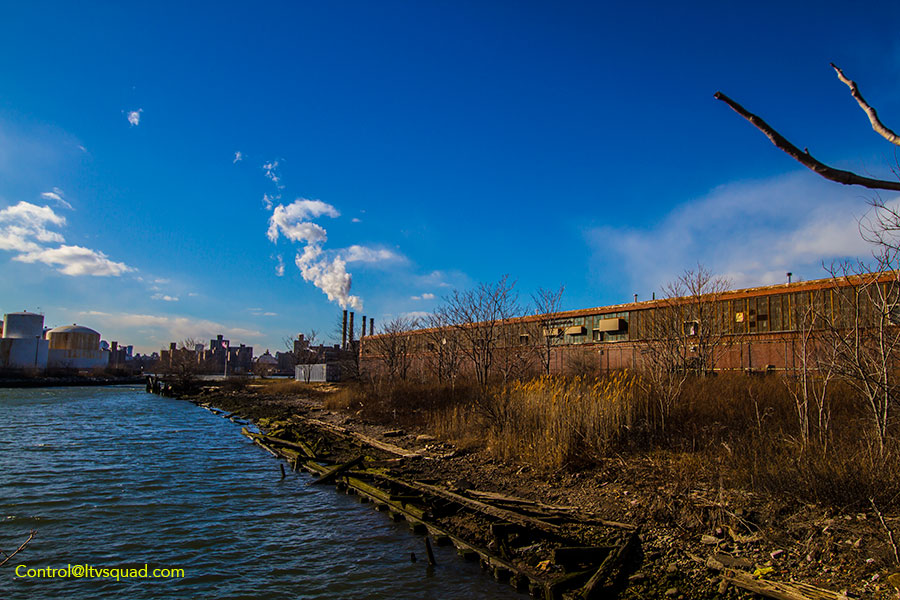
In 2005, a large swath of the north Brooklyn waterfront was rezoned. To gain community approval for this rezoning, a large 28 acre park surrounding Bushwick Inlet was promised, and never delivered.
Overview
This article is focused on the northern end of this parkland, though I will touch on the other properties that are in the full park proposal to provide some context into what a muddled fiasco this entire project has become.
History
This northernmost park property has a long, complicated history. It was original the western terminal of the Glendale and East River Railroad. This railroad was incorporated on March 26, 1874 to build a 3 ft (914 mm) narrow gauge line from Greenpoint east to Glendale, Queens. Though a series of transactions, it eventually fell into the hands of the Long Island Rail Road. Reluctant to modernize a route that had a narrow right of way (it could only accommodate one standard gauge track), the LIRR cut the tracks back east to Bushwick in October of 1885 (there were several freight customers in Bushwick – along tracks that eventually came to be known as the ‘evergreen branch’. These tracks were eventually abandoned in 1983).

Late 1800s map showing the railroad terminal.
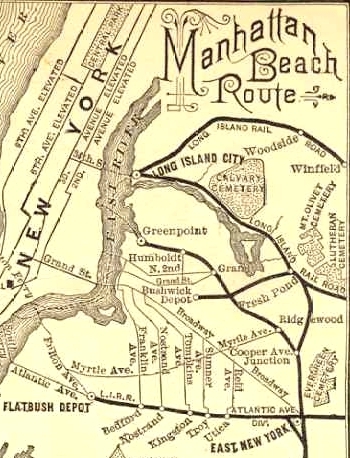
1884 Route Map of the New York and Manhattan Beach railroad, showing the Greenpoint segment of track.
Ownership changed hands several times over the decades, and today the property is owned by Motiva Enterprises LLC, a 50-50 joint venture between Saudi Refining and Shell Oil. Neither of them use this property for anything at all, other than to insult area residents by leaving it a polluted mess.
Much of this property seems to have been left abandoned after the tracks were pulled. A portion of the property on the north shore of the inlet remained cleared and undeveloped except for a dock and bulkhead that have since largely crumbled into the water. This corner of the property is supposed to be home to the Monitor museum, though nothing but a placard and flagpole exist here today. Closer to the street, large trees and tall grasses grew behind a long fence, isolating the land from the water.

Left to Right: Huge Hole, No Trespass sign, Park sign. Who’s property is this, anyway?
To the south, a thin strip of debris-filled weeds separates this property from the Bayside fuel depot with several large fuel storage tanks. This now closed depot represents one end of the Buckeye pipeline – used to bring jet fuel to LaGuardia and JFK airports. The city owns this property and remediation is expected to take years.
Neighbors and History of the Park Plan
Several community groups and journalists have done amazing work documenting the history of the Bushwick Inlet Park proposal. Today, only one small section of this park exists – located on former BEDT terminal property on Kent Avenue between North 9th and North 10th streets.
The rest of the proposed parkland is split between a storage facility (CitiStorage), former DSNY truck garage / superfund site (since bulldozed), the fuel terminal and the abandoned land that is the subject of this post.
Here’s a handy map:
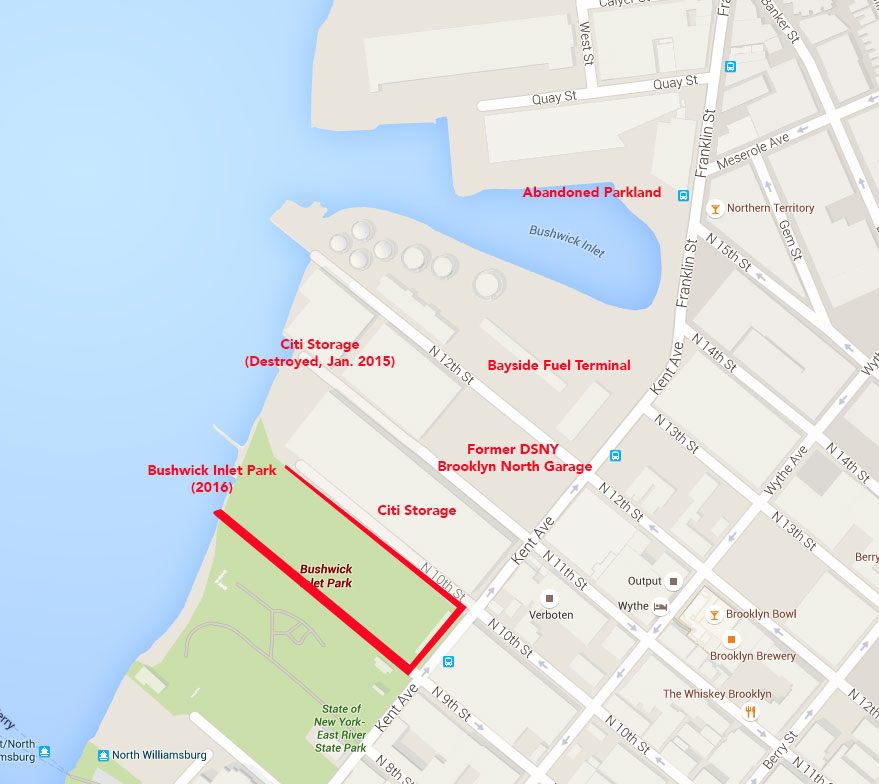
On this map, you’ll note the Citistorage facility. These buildings were built after Citistorage grabbed the property in a 1999 auction right out from under the city (and their inept partner, ‘Trust for Public Land’). At the time, The city, along with TPL and NYU, were trying to create one vast park on much of the former BEDT property.
One of the two large warehouses remains, while the other burned in a spectacular fire at the end of January, 2015. The cause of this fire was only recently reported to be a shorted out light that creates sparks. It’s pretty clear why it took a full year for the city to report this fact: There are now multiple lawsuits pending, and the city may share liability. FDNY showed up and put out a small fire that morning – only to be called back to the scene 2 hours later when the same building again erupted in flames. The building’s owner – Norm Brodsky – swears he lost everything in an apartment he lived in on location. Was it Arson? If so, by who? Brodsky claims to have lost everything that night (including reputation), though he didn’t win the public’s sympathy by immediately marketing the property for sale.
Arson is often a real estate owner’s tool of choice for clearing property. It wouldn’t be the first time this happened, resulting in a huge fire, right in this very neighborhood.
Whatever happened that night, one can only wonder if the fire would ever have burned out of control had former mayor Michael Bloomberg not closed down the firehouse that was located just 4 blocks away .

Destroyed Citistorage warehouse, first week of Feb, 2015.
In the immediate aftermath of this fire, there have been renewed protests in support of the park project. One took place March of 2015, while another took place last august. There is now a dedicated website tracking the progress (or lack thereof) on this park project.

Protest signage
Today
Today, this park project sits in limbo. Unless activists continue to hold their elected official’s feet to the fire, there will never be a park on this land. The NYC government has a horrible record on creating and especially maintaining parks. In 2010 residents of Maspeth were promised a park on the old St. Saviours church site. Today that land is warehouses. In Forest Hills, the Willow Lake Trail sat completely abandoned and locked up for over 20 years. (It was only reopened after we started reporting on it, and highlighting the waste and fraud involved).
Here’s a few more views from the northernmost property – surrounding the actual inlet.


Rare Ichabod block letters. Ichabod is one of the US’s best known freight train graffiti writers.


Abandoned ‘Monitor Museum’ site.


Locked away from the public, this northwest corner of the site is kept chained up for no good reason.


Leave a Reply